
Fifteen and a half trillion dollars is a stupid amount of money. Put it behind one company, add the software other financial institutions use to manage their portfolios, then give the company a seat at the table when the system catches fire. You begin to understand BlackRock.
The name sounds like something a screenwriter would invent for a corporation that owns the moon. In reality, you can buy its shares on the New York Stock Exchange under BLK. Its annual reports are public, its executives give interviews and its clients include people saving for retirement. Somehow, this makes the whole thing more impressive.
While everyone else argues about the next trade, BlackRock has spent decades making itself useful to the people placing the trades, the people funding them and the institutions asked to clean up afterwards. At some point, calling it a market participant starts to sound a little modest.
Assets under management at September 30, 2026.
Meet Larry.
He has also had a bad trade.

In the eighties, Larry Fink was running the mortgage trading desk at First Boston. Packaging mortgage payments into securities was a very good business, provided your models understood what those payments would do when interest rates moved.
Larry's team made $130 million in one quarter. In 1986, it also managed to lose $100 million after getting the direction of rates wrong and overestimating what its technology could tell it. The man who had been treated as a star suddenly had plenty of time to think about risk.
Most people respond to a professional humiliation by changing departments, moving cities or becoming unbearable on LinkedIn. Larry eventually decided to start an investment management company. If you have just fucked up a hundred million dollars, apparently the next move is to ask people for more money. Wall Street has always had a generous approach to second chances when the right people are involved.
BlackRock was founded in 1988 by Fink and seven partners, initially with Blackstone's backing. The selling point was a better understanding of risk. The expensive lesson at First Boston would become part of the product, and the product would become much bigger than the lesson.
Fink's desk loses $100 million at First Boston.
Fink and seven partners found BlackRock.
BlackRock goes public on the NYSE.
The BGI acquisition brings in iShares.
The company also bought its way into scale. Its $13.5 billion acquisition of Barclays Global Investors in 2009 brought the iShares ETF business and pushed assets under management to roughly $2.8 trillion. That is a fairly efficient way to make your competitors' Monday worse.
Aladdin lives in
the risk department.
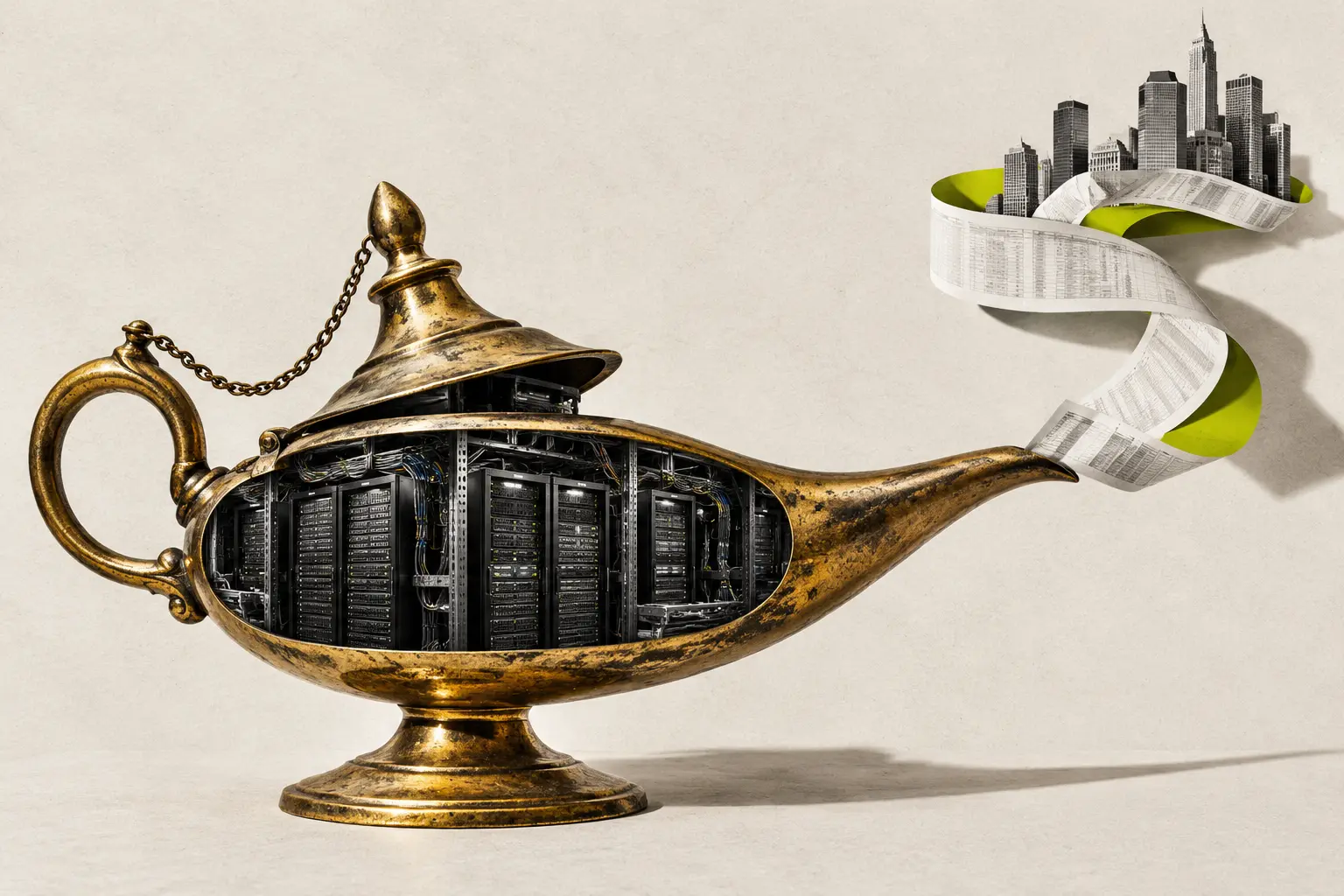
The most useful thing BlackRock built may be the thing you cannot buy through your broker. Aladdin is its investment technology platform, connecting portfolio management, risk analysis, trading and the unglamorous work that keeps an institution from losing track of what it owns.
Imagine buying a bond and being able to see how it changes the risks across the rest of your portfolio. What happens if rates jump, a currency falls or several supposedly different holdings turn out to depend on the same thing? That is the kind of problem the system is meant to help people examine before the market supplies its own answer.
Picture the machine inside BlackRock swallowing the world's information, calculating the consequences and leaving the rest of us to stare at a red candle. A money printer with unusually demanding onboarding. Then picture Larry renting the same machine to the people on the other side of the trade. Aladdin earns its keep inside BlackRock and brings in money from the institutions using it outside.
The institution sets its mandate and makes its investment decisions.
BlackRock says more than two hundred institutions use Aladdin or its risk analytics. They include asset managers, insurers, pensions, banks and official institutions. Some of the people competing for investment business can also be customers of the technology business. You have to admire the arrangement. Lose the mandate and there is still a chance you sell the winner its software.
Once a system sits across investment teams, compliance, accounting and operations, replacing it becomes a serious project. Someone has to move the data, reconnect the workflows and persuade a lot of busy people that the disruption will be worth it. My suspicion is that a considerable amount of financial power survives in the sentence, “Let's deal with the migration next year.”
In 2025, BlackRock reported about $2 billion of technology services and subscription revenue, with Aladdin accounting for the majority. A rather good business to own when everyone else is still trying to guess where the S&P 500 will close.
When things go to hell,
Washington knows whom to call.
A financial crisis is an inconvenient time to discover that nobody can agree on what the assets are worth. Institutions that can examine complicated portfolios, organize the information and help execute a response become extremely useful. BlackRock built a business around being one of those institutions.
In March 2020, the New York Fed hired BlackRock Financial Markets Advisory to help manage its emergency corporate credit facilities. The secondary market program bought corporate bonds and bond ETFs, including funds from BlackRock's own iShares range. Imagine selling the fire extinguisher and then being hired to help operate it. A very good position to be in, provided someone is reading the contract.
A mandate from the New York Fed.
- The client
- Federal Reserve Bank of New York
- The manager
- BlackRock Financial Markets Advisory
- The assignment
- Emergency corporate credit purchases
- The instructions
- Set and approved by the New York Fed
The terms required iShares ETF fees to be credited back and barred an additional asset management fee on ETF holdings.
Read the assignment ↗The Fed set the instructions. BlackRock supplied the machinery and the people. When public authorities needed a capable private operator in a hurry, Larry's company was already standing close enough to take the job. Being useful before everyone else has found the meeting invite is a powerful advantage.
The personnel traffic is just as interesting. Thomas Donilon, formerly Barack Obama's national security adviser, became chairman of the BlackRock Investment Institute. Brian Deese led sustainable investing at BlackRock before becoming director of Joe Biden's National Economic Council. The revolving door appears to be in excellent working order.

Having people who understand Washington, speak its language and know how decisions get made is worth something. So is being familiar to the people on the other end of the phone. Most businesses spend money trying to get an introduction. By this point, BlackRock hardly needs one.
The shareholder list
gets repetitive.
Open enough ownership tables and the same names begin to follow you around. BlackRock, Vanguard and State Street manage funds that hold enormous slices of listed markets. Their customers want broad exposure, so the portfolios contain the companies in those markets, including financial companies and sometimes other asset managers.
From a distance, the resulting ownership map looks like a conspiracy designed by somebody who has run out of wall space. Up close, a great deal of it is the entirely ordinary consequence of millions of people buying diversified funds. Ordinary behavior can still produce an extraordinary concentration of influence.
More than a billion shares.
Apple's 2026 proxy lists BlackRock with 1,043,713,019 shares of beneficial ownership.
in that proxy table
Those shares are held across funds and client mandates. Larry cannot sell your retirement portfolio and use the proceeds to buy himself a small country. But a manager may exercise voting authority over substantial holdings, and the companies receiving its calls are aware of the numbers involved.
The investor wants a cheap way to own the market. The manager gets paid to provide it, and corporate America ends up with a remarkably familiar set of institutional names on the register. You can explain the mechanics in a few sober sentences and still come away thinking the arrangement gives a small group of firms an awful lot of weight.
The firms still compete for customers. They also keep appearing in the same portfolios, meeting the same executives and depending on parts of the same financial machinery. Apparently the market is a small world once you can afford enough of it.
A small percentage
of a ridiculous number.
Asset management has a beautiful feature that the people losing money in the fund tend to appreciate less than the people running it. Many management fees are tied to the amount of money being managed. The client needs a good investment result, while the business also needs clients to keep their assets on the platform.
Keep the fee. Change the scale.
Simple arithmetic with a hypothetical fee and constant assets. This is not BlackRock's blended fee, a return forecast or a profit figure.
A falling market can shrink the fee base, and clients can take their money elsewhere. In 2022, market movements alone reduced BlackRock's assets under management by about $1.5 trillion. The company still reported roughly $17.9 billion in revenue that year. If your definition of winning requires every position to finish green, you are playing a much less forgiving game.
“They can't lose” is how it feels when you are paying for the trade and somebody else keeps billing for the machinery.
That is the attraction of the whole setup. Investment management brings one kind of income, technology brings another and institutional relationships help keep the business embedded in people's working lives. A bad market can hurt all of it, but the company has more to sell than a correct prediction.
By the time it makes the headline,
the machine is already there.
When BlackRock showed up in the spot bitcoin ETF race, the interesting part was how much of the distribution machine it could bring with it. An asset that had spent years promising an escape from traditional finance was about to become another product in a traditional investment account. Finance has a wonderful talent for selling people a convenient wrapper around their rebellion.
The SEC approved a group of US spot bitcoin exchange-traded products in January 2024, including BlackRock's. That approval followed a wider legal and regulatory process, with the Grayscale court decision playing a central role. By the time the approval arrived, BlackRock had a product ready for the people who wanted bitcoin exposure through a familiar investment account. The rebellion now had a ticker and a management fee.
The company that began after an expensive mortgage trading mistake now manages portfolios, supplies investment technology and has been hired to help authorities carry out emergency market operations. Each business gives it another reason to be in the room. Taken together, they make it hard to find a part of institutional finance where the name feels out of place.
For my money, this is the impressive part of Fink's career. Plenty of people on Wall Street have made a fortune from being right about a market. Larry helped build an organization that other people rely on while they are trying to be right about it. That is a much more comfortable chair.
And the market sends an invoice.
The record
This is an opinion column. The title and money-printer imagery are editorial metaphors. Figures below are dated snapshots.
The scale
BlackRock Q3 2026 earnings release ↗AUM of $15.488 trillion at September 30, 2026. AUM represents assets managed for clients, not BlackRock corporate cash.
The loss
Larry Fink, My Worst Trade ↗Fink’s own account of the $100 million loss at First Boston in 1986.
The acquisition
BlackRock 2017 annual report ↗The 2009 BGI purchase, its $13.5 billion price and $2.8 trillion combined AUM.
The software
Aladdin FAQs ↗Functions, users and the distinction between Aladdin and Aladdin Risk. The lamp is an editorial illustration. Risk analysis does not guarantee returns.
The technology business
BlackRock 2025 Form 10-K ↗About $2 billion in technology services and subscription revenue. Aladdin represented the majority of this category.
The assignment
New York Fed vendor terms ↗The Fed’s direction of the mandate and the provisions concerning ETF fees.
The appointment
New York Fed facility record ↗BlackRock FMA was retained on March 24, 2020. This was a specific service contract, not control of monetary policy.
The people
Thomas Donilon biography ↗Former US National Security Advisor and chairman of the BlackRock Investment Institute.
The other direction
Brian Deese biography ↗BlackRock sustainable investing and the Biden administration’s National Economic Council.
The ownership table
Apple 2026 proxy statement ↗Page 81 lists 1,043,713,019 shares and 7.10% for BlackRock. Footnote 3 identifies the underlying holding as a December 31, 2023 disclosure.
The bad year
BlackRock 2022 Form 10-K ↗Market changes reduced AUM by $1.502 trillion in 2022. Reported revenue was $17.873 billion. AUM changes are not corporate trading losses.
The ETF approval
SEC statement, January 10, 2024 ↗The spot bitcoin ETP approvals and the role of the Grayscale court ruling.
Photography: Kena Betancur / European Commission ↗, © European Union, CC BY 4.0 ↗. Portrait cropped from the same photograph by Ptrnext. Images resized for this page. Cover and lamp: editorial illustrations created for ANSIO with image-generation tools.